
You are currently browsing the monthly archive for July 2017.
My best friend of fifty years flew down from Potomac MD the last week of June to visit us for a couple of days.
June is actually the anniversary of our having met, that incident having occurred in line waiting to get into a movie theatre. We were standing together, he talking to his companion ahead and me talking to my companion behind. Overhearing bits of each other’s conversations, we introduced ourselves.
We talked on the phone for about an hour and a half yesterday, and this piece of the movie ‘The Curious Case of Benjamin Button’ came up. The infinite ‘incidents out of anyone’s control’ are invisible, of course, but the ones we can pinpoint in hindsight as having steered us from catastrophe? [brief quiver]
And this has to do with you how? Well, for starters, a dead Dave would not be posting for your delight. So, there.
I must have things spoon-fed to me, I’m just that lazy.
This David Brooks piece in today’s New York Times is fascinating to me, and not at all because of the Donald Trump ‘point’. As a matter of fact, I reached my limit on Donald Trump ‘points’ some time ago. He is not a fit subject for parsing. There is nothing there to parse, only something to be gotten past.
Our nightmare can draw to a close when, on live television, in an orange-tinted, sulphur-scented cloud of smoke, winged minions drag him live to Hell, like the end of Don Giovanni. A boy can dream.
– – – – – – – – –
Getting Radical About Inequality
David Brooks
JULY 18, 2017
I’m not in the habit of recommending left-wing French intellectuals, but I’m beginning to think that Pierre Bourdieu is helpful reading in the age of Trump. He was born in 1930, the son of a small-town postal worker. By the time he died in 2002, he had become perhaps the world’s most influential sociologist within the academy, and largely unknown outside of it.
His great subject was the struggle for power in society, especially cultural and social power. We all possess, he argued, certain forms of social capital. A person might have academic capital (the right degrees from the right schools), linguistic capital (a facility with words), cultural capital (knowledge of cuisine or music or some such) or symbolic capital (awards or markers of prestige). These are all forms of wealth you bring to the social marketplace.
In addition, and more important, we all possess and live within what Bourdieu called a habitus. A habitus is a body of conscious and tacit knowledge of how to travel through the world, which gives rise to mannerisms, tastes, opinions and conversational style. A habitus is an intuitive feel for the social game. It’s the sort of thing you get inculcated with unconsciously, by growing up in a certain sort of family or by sharing a sensibility with a certain group of friends.
For example, in his surveys of French taste, Bourdieu found that manual laborers liked Strauss’s “The Blue Danube” but didn’t like Bach’s “The Well-Tempered Clavier.” People who lived in academic communities, on the other hand, liked the latter but not the former.
Your habitus is what enables you to decode cultural artifacts, to feel comfortable in one setting but maybe not in another. Taste overlaps with social position; taste classifies the classified.
Every day, Bourdieu argued, we take our stores of social capital and our habitus and we compete in the symbolic marketplace. We vie as individuals and as members of our class for prestige, distinction and, above all, the power of consecration — the power to define for society what is right, what is “natural,” what is “best.”
The symbolic marketplace is like the commercial marketplace; it’s a billion small bids for distinction, prestige, attention and superiority.
Every minute or hour, in ways we’re not even conscious of, we as individuals and members of our class are competing for dominance and respect. We seek to topple those who have higher standing than us and we seek to wall off those who are down below. Or, we seek to take one form of capital, say linguistic ability, and convert it into another kind of capital, a good job.
Most groups conceal their naked power grabs under a veil of intellectual or aesthetic purity. Bourdieu used the phrase “symbolic violence” to suggest how vicious this competition can get, and he didn’t even live long enough to get a load of Twitter and other social media.
Different groups and individuals use different social strategies, depending on their position in the field.
People at the top, he observed, tend to adopt a reserved and understated personal style that shows they are far above the “assertive, attention-seeking strategies which expose the pretensions of the young pretenders.” People at the bottom of any field, on the other hand, don’t have a lot of accomplishment to wave about, but they can use snark and sarcasm to demonstrate the superior sensibilities.
Sometimes, the loser wins: If you’re setting up a fancy clothing or food shop you go down and adopt organic and peasant styles in order to establish the superior moral prestige that you can then use to make gobs of money.
Bourdieu helps you understand what Donald Trump is all about. Trump is not much of a policy maven, but he’s a genius at the symbolic warfare Bourdieu described. He’s a genius at upending the social rules and hierarchies that the establishment classes (of both right and left) have used to maintain dominance.
Bourdieu didn’t argue that cultural inequality creates economic inequality, but that it widens and it legitimizes it.
That’s true, but as the information economy has become more enveloping, cultural capital and economic capital have become ever more intertwined. Individuals and classes that are good at winning the cultural competitions Bourdieu described tend to dominate the places where economic opportunity is richest; they tend to harmonize with affluent networks and do well financially.
Moreover, Bourdieu reminds us that the drive to create inequality is an endemic social sin. Every hour most of us, unconsciously or not, try to win subtle status points, earn cultural affirmation, develop our tastes, promote our lifestyles and advance our class. All of those microbehaviors open up social distances, which then, by the by, open up geographic and economic gaps.
Bourdieu radicalizes, widens and deepens one’s view of inequality. His work suggests that the responses to it are going to have to be more profound, both on a personal level — resisting the competitive, ego-driven aspects of social networking and display — and on a national one.
Quite a few months ago, someone at Stephen’s store recommended a Netflix offering that ran on Turkish television from 2011 to 2014, called ‘Muhteşem Yüzyıl’ (‘The Magnificent Century’). Grand title aside, it’s a soap opera.
The series fictionalizes palace intrigue during the reign of ‘Sultan Süleyman the Magnificent’. The recommendation, as it turns out, was based on ‘you must see the costumes’ and not much more. And yet…

Now, whereas I contend — and can never be persuaded otherwise — that male beauty in every aspect reached its zenith in John F. Kennedy, Jr., there are other extremely attractive men in the world, including the actor portraying Süleyman in this show, Halit Ergenç.
Every so often for the last number of months, we will have watched an episode or two (there are 48, we’re at 37), during which it was de rigueur to say out loud two and three times: ‘Now that’s a good-looking man!’

The show is terrible, and the actress in the female lead, Meryem Uzerli, is so wonderfully terrible that we have taken to imitating her delivery expressing this or that emotion around the house. Stephen has her down, but the character itself is the ideal of petulance and willfulness, so it’s really not that much of a leap.
I will deny having said that.
Tab Hunter is 86 years old today.
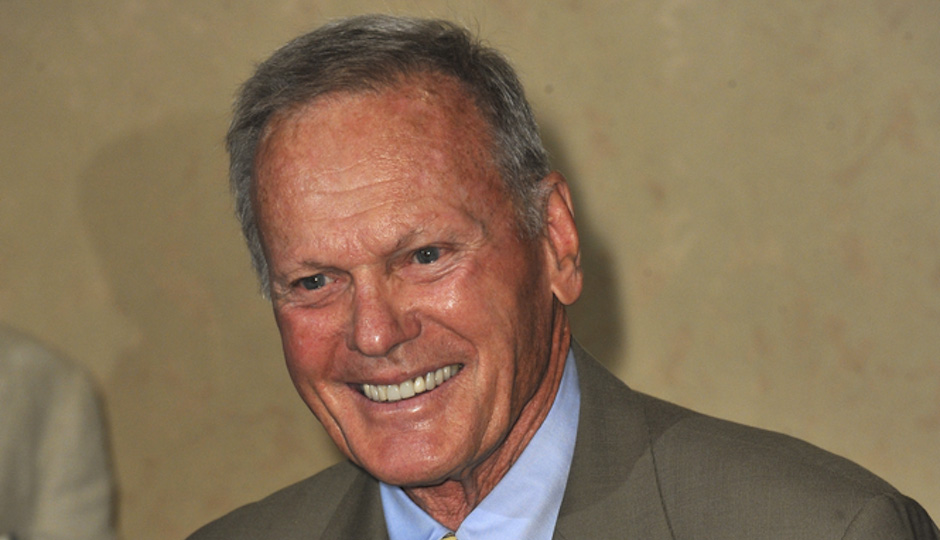
Somewhere around the house, I have a ’45’ of his Dot Records hit ‘Young Love’, which was released January 19th, 1957 (the day before my own 10th birthday) and stayed at #1 on the Billboard chart for 6 weeks.
Somewhere around the house, I have an original ‘Odorama’ card from the John Waters film ‘Polyester’, starring Tab Hunter and Divine.

These are bits of information you had no idea you would acquire today.
Just a guess.
This museum project I’ve been working on is… still going on. I’m headed to the museum after I post this. My enthusiasm, etc, etc has diminished somewhat. (Imagine that.) HowEVER, the other week I did get a lovely citation and a lovely bottle of Prosecco.
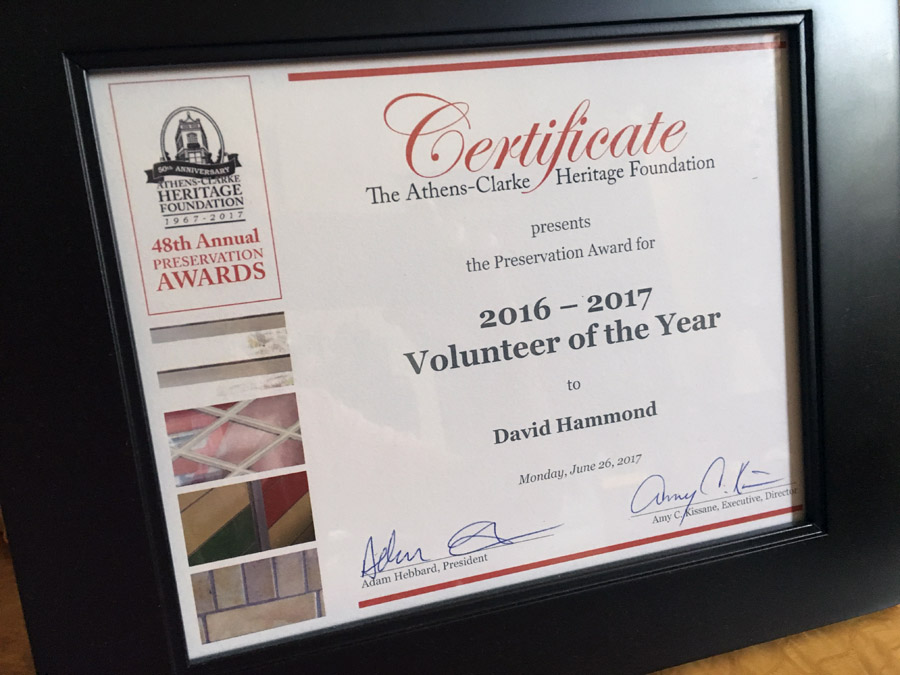
I hope Tab gets a lovely bottle of Prosecco today. Actually, we can share mine.
 domanidave.com